 6 min read
WORKPLACE INJURY TREATMENT: IMMEDIATE CARE, DOCUMENTATION, RECOVERY TIME & EMPLOYER GUIDELINES
You twisted your back lifting a heavy box at work. A piece of equipment nicked your hand. You slipped on a wet floor and landed hard on your wrist. Workplace injuries happen every day, and knowing what to do in the immediate aftermath makes a significant difference in your recovery, your medical bills, and your workers' compensation claim.
The Bureau of Labor Statistics reports that approximately 2.6 million nonfatal workplace injuries and illnesses occur in private industry each year. Many of these injuries are treatable at an urgent care clinic without an emergency room visit, saving both time and money for employees and employers.
This guide covers what to do immediately after a workplace injury, how to get treatment, what documentation is needed, what recovery looks like, and how workers' compensation fits into the process.
Immediate Steps After a Workplace Injury
What you do in the first hours after a workplace injury can affect both your health and your ability to receive workers' compensation benefits.
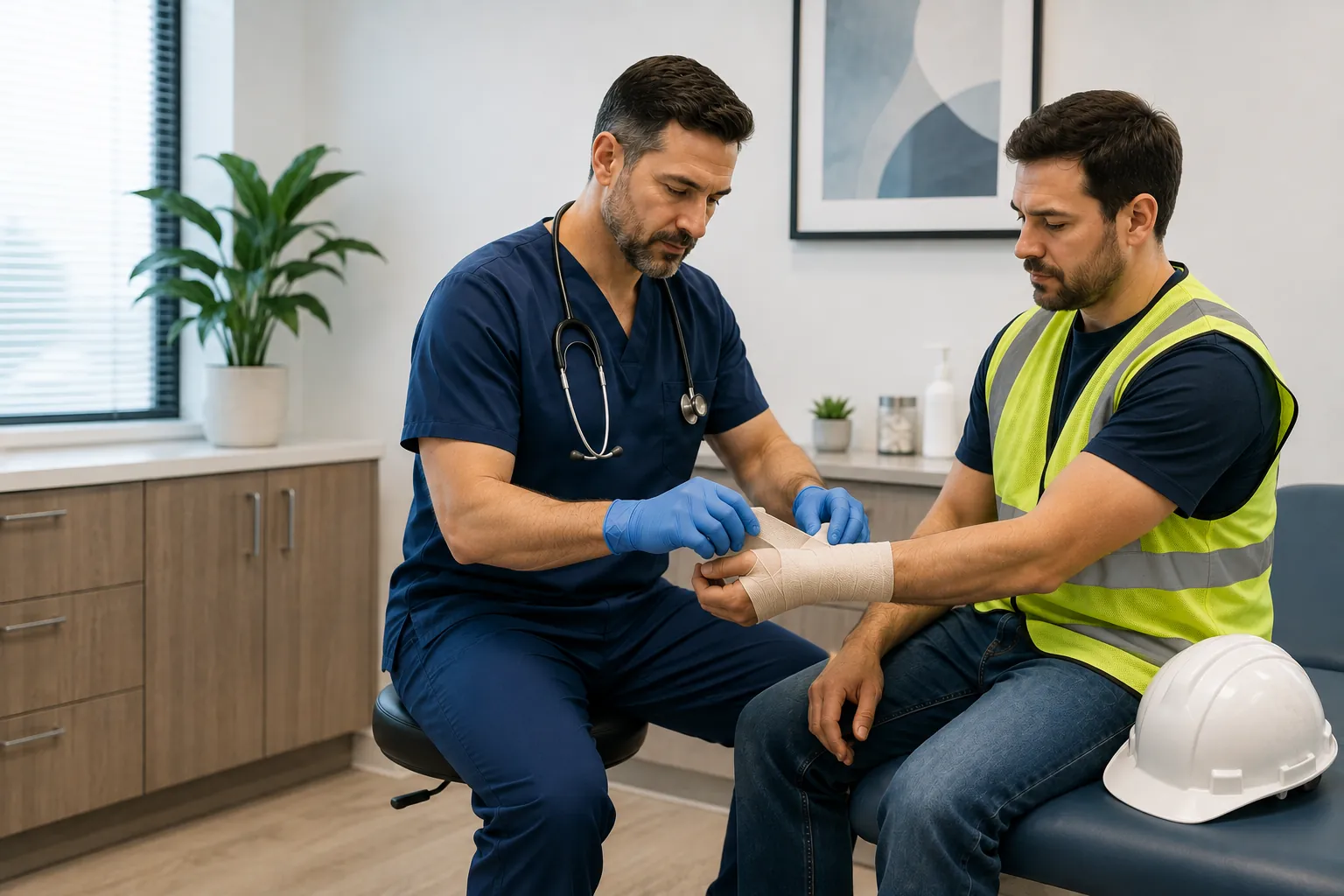
Step 1: Report the injury to your supervisor or manager immediately. In California, you are required to report work injuries to your employer within 30 days, but reporting as soon as possible protects your rights and creates a documented timeline. Step 2: Seek medical attention. For non-emergency injuries, you can visit an urgent care clinic rather than an ER. This gets you faster care at lower cost. For life-threatening injuries, call 911 immediately.
Step 3: Document everything. Write down how the injury happened, when it occurred, who witnessed it, and what symptoms you are experiencing. Take photos of the injury and the conditions that caused it if possible. Step 4: File a workers' compensation claim. Your employer is required to provide you with a claim form (DWC-1 in California) within one working day of learning about your injury.
Treating Common Workplace Injuries at Urgent Care
Strains and Sprains
Back strains, shoulder injuries, and ankle sprains are among the most common workplace injuries. Treatment includes rest, ice, compression, and elevation (RICE), along with anti-inflammatory medications and, when needed, physical therapy referrals. Providers may order X-rays to rule out fractures.
Cuts and Lacerations
Cuts from tools, machinery, or sharp materials require proper wound cleaning, possible sutures or wound adhesive, and tetanus booster if needed. Minor injury treatment at Mederi Urgent Care includes wound care for workplace lacerations of all sizes.
Burns
Thermal, chemical, and electrical burns range from mild to severe. First- and second-degree burns are treated at urgent care with wound cleaning, burn dressings, pain management, and follow-up care instructions. Third-degree burns require emergency care.
Repetitive Motion Injuries
Carpal tunnel syndrome, tendinitis, and other repetitive stress injuries develop over time from repeated motions or sustained awkward positions. Initial evaluation at urgent care includes assessment, splinting if appropriate, anti-inflammatory treatment, and referral to an occupational medicine specialist or physical therapist.
Eye Injuries
Foreign objects in the eye, chemical splashes, and impact injuries are common in construction, manufacturing, and laboratory settings. Urgent care providers can flush the eye, remove superficial foreign bodies, and determine whether specialist evaluation is needed.
Documentation Requirements for Workers' Compensation
Proper documentation is critical for a successful workers' compensation claim. The medical record from your treatment visit should include a clear description of the injury, how it occurred, and the work activities that caused it, along with the date, time, and location of the injury, diagnosis and treatment plan, work restrictions and limitations, estimated recovery timeline, and follow-up care schedule.
Your urgent care provider creates this documentation during your visit. Be thorough and specific when describing how the injury happened. Vague descriptions can complicate your claim later.
Recovery Timelines for Common Injuries
Recovery time varies by injury type and severity. Here are general timelines for common workplace injuries:
Minor cuts and lacerations: 1 to 2 weeks for healing, return to work often the same day with wound protection. Sprains and strains (mild to moderate): 1 to 6 weeks depending on severity, with restricted duties during recovery. Back injuries: 2 to 8 weeks for most strains, longer for disc injuries or more severe conditions. Fractures: 4 to 12 weeks depending on location and severity, with modified duties during healing. Burns (first and second degree): 1 to 3 weeks for mild burns, several weeks for larger second-degree burns. Repetitive motion injuries: Weeks to months, depending on severity and whether work modifications are implemented.
Your provider will set specific work restrictions, such as lifting limits, activity modifications, or temporary job reassignment, based on your injury. These restrictions protect your recovery and are part of your workers' compensation documentation.
Employer Responsibilities and Employee Rights
Employer Obligations
In California, employers are required to carry workers' compensation insurance, provide a claim form within one working day of learning about an injury, authorize up to $10,000 in medical treatment while the claim is being reviewed, post workers' compensation information in the workplace, and not retaliate against employees for filing claims.
Employee Rights
As an injured worker, you have the right to receive medical treatment for your injury, file a workers' compensation claim, see a doctor of your choice after 30 days (or immediately if you pre-designated a physician), receive temporary disability payments if you cannot work during recovery, and return to your job when medically cleared. If your employer does not have workers' compensation coverage or refuses to file a claim, you can contact the California Division of Workers' Compensation for assistance.
Frequently Asked Questions
Can I go to urgent care for a work injury instead of the ER?
Yes. For non-life-threatening injuries, urgent care is often the better choice. It provides faster treatment, lower costs, and the same documentation required for workers' compensation claims.
Who pays for my workplace injury treatment?
Workers' compensation insurance covers the cost of medical treatment for work-related injuries. You should not receive a bill for authorized treatment related to your workplace injury.
What if my employer says I cannot file a claim?
Every employer in California is required by law to carry workers' compensation insurance and process claims. If your employer refuses to provide a claim form or discourages you from filing, contact the California Division of Workers' Compensation at 1-800-736-7401.
Do I need to use my employer's doctor?
In California, your employer may direct you to a specific provider for the first 30 days. After that, you can choose your own treating physician. If you pre-designated a personal physician before the injury, you can see them from day one.
Get Treated for Your Work Injury Today
Workplace injuries need prompt, professional treatment and thorough documentation. Visiting an urgent care clinic gets you both, without the cost and wait time of the emergency room.
Mederi Urgent Care treats workplace injuries at all four Los Angeles locations, seven days a week. Walk in or call 213-442-1890. Visit Mederi Urgent Care to plan your visit.

You Might Also Enjoy...

Primary Care vs Urgent Care: Differences, When to Visit Each, Cost Comparison & How They Work Together
Not sure whether to visit primary care or urgent care? Compare costs, services, when to choose each, and how they complement your healthcare at Mederi Urgent Care LA.

Allergy Symptoms & Treatment: Seasonal, Food & Skin Allergies, Testing, Medications & When to Get Help
Dealing with allergy symptoms? Learn about seasonal, food, and skin allergies, available testing, medications, and when to seek same-day treatment at Mederi Urgent Care LA.